


Stewardship and Ecological Threats: Tuliptree Small-Stream Floodplain Forest in Rock Creek Park
The composition or abundance of species in a natural community can be threatened by a variety of factors, such as invasion by non-native invasive plants or insects. Good stewardship strategies can help mitigate the damage. For stewardship information specific to this natural community, scroll to the bottom of the page.
Here's how you can help protect natural communities:
Ecobit: Stewardship at Home and While Visiting Rock Creek Park
Ecobit: Is Your Property Watershed-Friendly?
Image gallery loading....
72157644460933579
Current and potential ecological threats for the Tuliptree Small-Stream Floodplain Forest in Rock Creek Park include the following:
- Flash flooding: erosion from high volume, velocity, and duration of floodwaters; polluted urban and agricultural stormwater runoff
- Manmade obstructions on floodplains: increased height/breadth of floods; degradation of habitat
- Manmade obstructions or channelization in streams: degradation of habitat for migrating fish, aquatic creatures
- Long-term drought: growth of flood-intolerant trees and shrubs that will not survive future flood cycles
- Excessive deer browse: decimation of wildflowers, some tree seedlings and shrubs (but not pungent northern spicebush or pawpaw)
- Emerald ash borer (potential): damage to green ash
- Viburnum leaf beetle (potential): damage to blackhaw and southern arrow-wood
- Asian long-horned beetle (potential): damage to maples, box-elder, elms, river birch, American sycamore, and willow
- Dutch elm disease: damage to American elm and slippery elm
- Elm yellows (potential): damage to American elm and slippery elm
- Non-native invasive plants: competition with natives for soil nutrients, sunlight, and pollinators; degradation of animal habitat
Non-Native Invasive Plants
The Tuliptree Small-Stream Floodplain Forest is particularly vulnerable to non-native invasive plants. Its nutrient-rich floodplain terrace sediments and sun-soaked sand/gravel bars are good "real estate," and frequent disturbance by flooding clears space for seeds and plant parts washed in from residential areas and woods upstream.
Though any number of non-native invasive plants may take root here, only flood-tolerant plant species survive long. Among the most aggressive are the yellow-blooming lesser celandine (which forms a carpet along many of Rock Creek Park's floodplains), Japanese stiltgrass, Japanese knotweed, and Japanese honeysuckle. Ecobit: Lesser Celandine in Rock Creek Park (* indicates non-native)
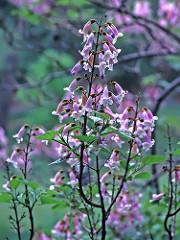 The purple blooms of the non-native invasive princess tree produce thousands of seeds each year.
Photographer: Gary Flemingbeefsteak plant* (low plant)- bush honeysuckle* (shrub)
- Chinese wisteria* (vine)
- common barberry* (shrub)
- common periwinkle* (vine)
- English ivy* (vine)
- garlic mustard* (low plant)
- ground-ivy* (low plant)
- Indian-strawberry* (low plant)
- Japanese barberry* (shrub)
- Japanese honeysuckle* (vine)
- Japanese hop* (shrub)
- Japanese knotweed* (low plant)
- Japanese maple* (tree)
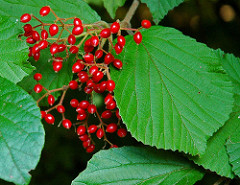 The highly invasive non-native shrub linden arrow-wood is a problem at Rock Creek Park.
Photographer: Gary FlemingJapanese snowball* (shrub)- Japanese snowbell* (shrub)
- Japanese stiltgrass* (low plant)
- lesser celandine* (low plant)
- linden arrow-wood* (shrub)
- mile-a-minute weed* (vine)
- multiflora rose* (shrub)
- Norway maple* (tree)
- oriental bittersweet* (vine)
- porcelain-berry* (vine)
- princess-tree* (tree)
- privets* (shrub)
- silktree* (tree)
- tree-of-heaven* (tree)
- wine raspberry (shrub)
- winged burning-bush (shrub)
- winter-flowering cherry* (tree)
Stewardship
Here are a few ways National Park Service (NPS) staff are managing ecological threats to the Tuliptree Small-Stream Floodplain Forest:
- Non-native invasive plants: NPS staff are actively removing non-native invasive plants from previously selected areas, using a variety of methods
- Manmade obstructions in streams and floodplains: Rock Creek Fish Passage
- Polluted urban and agricultural stormwater runoff: NPS staff use strategies to filter and slow stormwater runoff such as the cattail-filled wetland swales in the Fort Circle Parks area northeast of the main Rock Creek Park unit
- Flash flooding: The District of Columbia and NPS staff engage in stormwater runoff reduction efforts
Ecobit: Rain, Rain, Go Away—But Where? - Excessive deer browse: A deer management plan in place since 2012 uses lethal and non-lethal means to control the white-tailed deer population1
- Potential arrival of diseases and invasive insects: NPS staff is watchful and asks visitors to be on the lookout, too
Ecobit: An Extra Set of Eyes