

Natural Processes & the Broader Landscape: Tuliptree Small-Stream Floodplain Forest in Rock Creek Park
Natural Processes
What is responsible for forming and maintaining the “patterns” that we recognize as this natural community? What shapes the land, forms the soil and topsoil, influences the water supply and all the other things that bring and keep this suite of plants together? Natural processes. (Ecobit: Natural Processes)
Important natural processes in the Tuliptree Small-Stream Floodplain Forest include
- flooding
- erosion
- sedimentation
- groundwater processes
Large Scale Natural Processes and Ecological Systems
Some natural processes—such as groundwater processes—act on large scales and affect more than one natural community at a time. For example, in Rock Creek Park, the movement of groundwater and changes in the height of the water table affect not only the Tuliptree Small-Stream Floodplain Forest, but also the Red Maple Seepage Swamp.
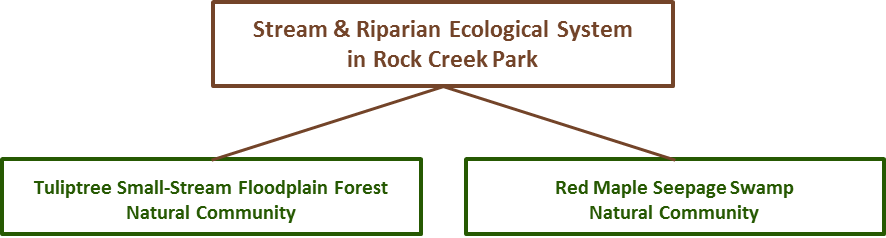
In fact, these two natural communities can be grouped into a larger landscape unit that ecologists refer to as the Stream and Riparian Ecological System. An ecological system is a group of several natural communities in the same vicinity that share many of the same natural processes and aspects of physical setting. By extension, they may also share many of the same plant and animal species.
Explore This Ecological System
Click the chart below to learn about this ecological system and its natural processes.