


Characteristic Species: Coastal Plain Oak Forest in Rock Creek Park
| Canopy Trees | Photo Album |
|---|---|
|
The canopy of this community consists mainly of oaks with occasional pines. The most common oaks here are southern red oak, willow oak, and white oak, with occasional other oaks, such as northern red, chestnut, and scarlet. Pine trees may include Virginia pine or loblolly pine. Willow oak is more common in D.C.'s Coastal Plain than Piedmont, and helps set the Coastal Plain Oak Forest apart from other oak communities in Rock Creek Park's Piedmont. Southern red oak is also more common here than elsewhere in the park. |
|
| Understory Trees | Photo Album |
|
Blackgum, red maple, black cherry, American holly, and elm can be found in the understory, along with an occasional flowering dogwood or sweetgum. Sweetgum is more common in D.C.'s Coastal Plain than Piedmont, and helps set the Coastal Plain Oak Forest apart from other natural communities at Rock Creek Park. |
|
| Shrubs, Saplings, and Vines | Photo Album |
|
Vines are common here—greenbriers, poison ivy, and non-native species—and so are non-native shrubs. You might also find native sassafras or white ash saplings, and blackberries. |
|
| Low Plants (Field Layer) | Photo Album |
|
The field layer is sparse, and unfortunately, often composed of non-native invasive plants. |
Non-native Invasive Plants
A significant component of this community is the numerous non-native invasive species, from trees to low-growing plants! Be sure to read about them in Stewardship and Ecological Threats.
In Brief
Mature oaks and occasional pines populate the canopy of the Coastal Plain Oak Forest. Smaller native and non-native trees grow below that, and a riot of vines (mostly non-native or thorny or poisonous) and shrubs (mostly non-native) often grow tangled below that. Not much sunlight is left for the forest floor, which helps explain why the shade-loving non-native invasive garlic mustard* is abundant there. (* indicates non-native)
Two of the characteristic oaks, willow oak and/or southern red oak, are common oaks in Coastal Plain areas where the ground has been heavily disturbed. Mature Virginia pine (another clue to past soil disturbance) is finally aging out of some of these stands, but is still significant in others. In brief, the oldest vegetation here gives clues to this land's disturbed past.
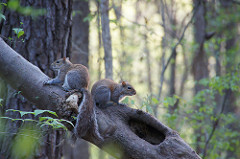
The home range of the eastern gray squirrel averages 2 to 5 acres (1 to 2 hectares).
Photographer: Matt JonesSince these forest stands are generally small, and bordered by urban neighborhoods, animals that thrive here are the types that don't need vast stretches of good habitat to get by.
The acorns are good wildlife food for small mammals like squirrels.
Birds can feed on berries and seeds from vines, trees, and shrubs such as blackgum, red maple, black cherry, pine trees, American holly, poison ivy, greenbriers, and flowering dogwood.
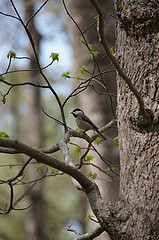 The Carolina chickadee is around all year.
Photographer: Matt JonesThe Coastal Plain Oak Forest is a good place to see resident (non-migrating) birds such as the robin, cardinal, Carolina chickadee, tufted titmouse, Carolina wren, blue jay, white-breasted nuthatch, eastern towhee, song sparrow, mockingbird, mourning dove, or red-bellied woodpecker. Because of all the forest edges, expect to occasionally see red-shouldered hawks preying on squirrels or birds.