


Physical Setting: Chestnut Oak / Mountain Laurel Forest in Rock Creek Park
Stand size: Small, isolated stands.
Landscape position: Some hilltops, ridges, and convex upper slopes.
Soils: Well-drained / dry, infertile, acidic, coarse to loamy soil, often with smooth stones (ancient river terraces)
Geology: Primarily Potomac Formation (ancient river terraces).
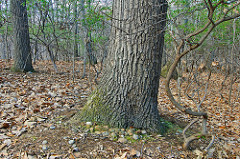 Round cobblestones on a hilltop that hosts the Chestnut Oak / Mountain Laurel Forest.
Photographer: Gary FlemingMost of the few and scattered stands of Chestnut Oak / Mountain Laurel Forest in Rock Creek Park grow on hilltops, atop remnants of ancient river terraces consisting of cobbles, gravel and/or sand. These gravels and sands were deposited by a prehistoric river. Later, the land was lifted up by tectonic forces, leaving these deposits high and dry. Ecobit: Ridgetop River Terrace Riddle
The soils on these hilltops and convex upper slopes are among the driest in Rock Creek Park because they are exposed to wind and sun from all directions. Rainwater percolates quickly through the coarse soil on these high surfaces, leaching away basic elements like calcium and magnesium and creating an acidic soil. Only a few plants thrive here due to the challenging conditions, which is why the natural community appears to consist almost entirely of two plant species well-suited to dry acidic soils—chestnut oak and mountain laurel.
Notable Variations
In Rock Creek Park, Chestnut Oak / Mountain Laurel Forest is usually found growing on the cobblestones of ancient river terraces that top some of the hills in Rock Creek Park and the surrounding area. This characteristic is not typical of Chestnut Oak / Mountain Laurel Forest elsewhere.