
Characteristic Species: Chestnut Oak / Mountain Laurel Forest in Rock Creek Park
| Canopy Trees | Photo Album |
|---|---|
|
The Chestnut Oak / Mountain Laurel Forest is characterized, not surprisingly, by chestnut oak trees, noted for their distinctive leaves—egg-shaped with scalloped margins—and their strongly ridged bark. |
|
| Understory Trees | Photo Album |
|
Blackgum is a tree commonly found beneath the canopy of chestnut oaks in this forest. It is one of the first trees to turn color in early October—a brilliant orange-red hue. |
|
| Shrubs, Saplings, and Vines | Photo Album |
|
Beneath the trees is a dense layer of mountain laurel shrubs with shiny leathery evergreen leaves and twisted trunks. Look for the striking white-and-pink flowers of mountain laurel in early June—they contrast remarkably well against the shrub’s dark green leaves. Pink azalea is another showy shrub that might be found here, with white to pink flowers that bloom in mid-spring, before the mountain laurel. Scattered throughout this forest’s floor are small, deer-browsed hillside blueberry and black huckleberry bushes whose fruit ripens in summer. In the fall, the leaves of black huckleberry bushes turn a brilliant deep scarlet color. All of these shrubs are in the heath family. Ecobit: Heaths |
|
| Low Plants (Field Layer) | Photo Album |
| The dense cover of mountain laurel and potentially extensive colonies of blueberry and huckleberry bushes cast a dark shade on the canopy floor. Few wildflowers and grasses—either native or non-native—grow in their shadow on the coarse, infertile soils. |
|
Non-native Invasive Plants
Because of the harsh living conditions here, non-native invasive plants wouldn't normally be too much of a problem in this natural community. However, with some forest stands bordered by residential neighborhoods, there are constant seeds sources for non-native plants. Read about them in Stewardship & Ecological Threats.
In Brief
The Chestnut Oak / Mountain Laurel Forest has the look of a rugged survivor, with its deeply furrowed chestnut oak trunks towering over twisted branches of mountain laurel, all growing out of a cobble-strewn forest floor. Species diversity is low—you’ll see mostly chestnut oaks and mountain laurel—and the field layer contains little else besides chestnut oak seedlings.
Notable Variations
Today, American beech and red maple saplings or small trees are regularly encountered in the understory of this forest at Rock Creek Park, though they were almost certainly less common in the Chestnut Oak / Mountain Laurel Forest historically. Ecobit: Case Study: American Beech Though these species are not likely to become as dominant in this community as in more mesic communities in the park, continued lack of fire may eventually result in American beech joining the canopy of the forest. This would change not only the species composition of the Chestnut Oak / Mountain Laurel Forest, but also its function as a fire-hardy forest on naturally fire-prone ridgetops.
This forest was intensively harvested for charcoal fuel production during early European settlement and the Civil War era. Telltale signs of historic logging include two or more trees sharing one trunk at the base (often the result of stump sprouting).
In some stands of Chestnut Oak / Mountain Laurel Forest that were intensely disturbed during the 1860s, mountain laurel is lacking. In fact, the understory has few native shrubs (none from the heath family) and very little ground cover for reasons that are unclear. We identify these stands, located on upper slopes or hilltops, as lower quality examples of the Chestnut Oak / Mountain Laurel Forest because the canopy is still predominantly comprised of chestnut oaks (though northern red oak may be a significant minority). One example of this can be seen on the north side of Fort DeRussey (where, unfortunately, linden arrow-wood* is abundant). (* indicates non-native)
Though the Chestnut Oak / Mountain Laurel Forest has one of the lowest species richness of any of Rock Creek Park’s forests, it still has much to offer the park’s wildlife. Chestnut oak acorns (over an inch in length) are among the largest of any Eastern U.S. oak tree and are an important food source for many of the area’s animals.
The fleshy berries of the occasional hillside blueberry and black huckleberry bushes are eaten by squirrels, chipmunks, and many species of birds, but the fruit of mountain laurel (a dry, woody capsule) doesn’t appear to be a significant food source for wildlife. Deer browse the twigs and leaves of all these shrubs. Although they don’t seem to care much for chestnut oak seedlings (except under duress), deer do eat the acorns of chestnut oak.
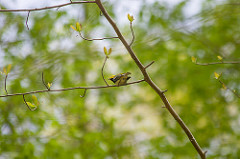 Black-throated green warbler (Setophaga virens) on blackgum (Nyssa sylvatica) in spring migration.
Photographer: Sam ShelineBecause it occurs on some of the highest elevations in the park—places which get early morning sun—this community may be a good place to see migratory songbirds during spring and fall migration periods.
Wildlife finds shelter (from cold winter weather and from predators) in the dense evergreen foliage of mountain laurel. Red fox, a shy hunter, may frequent this forest.
Fallen dead trees, slowly returning their nutrients to the forest floor as they decompose, are great places for invertebrates and small mammals such as chipmunks and mice to find homes. Standing dead trees are preferred cavity nesting habitat for woodpeckers, squirrels, and many other animals.