


Stewardship and Ecological Threats: Chestnut Oak / Mountain Laurel Forest in Rock Creek Park
The composition or abundance of species in a natural community can be threatened by a variety of factors, such as invasion by non-native invasive plants or insects. Good stewardship strategies can help mitigate the damage. For stewardship information specific to this natural community, scroll to the bottom of the page.
Here’s how you can help protect natural communities:
Ecobit: Stewardship at Home and While Visiting Rock Creek Park
Image gallery loading....
72157648644632018
Current and potential ecological threats for the Chestnut Oak / Mountain Laurel Forest in Rock Creek Park include these:
- Excessive deer browse: decimation of shrubs and oak seedlings
- Lack of fire: encroachment by fire-sensitive species like American beech; disease
- Gypsy moth: damage to oaks
- Dogwood anthracnose: decline of flowering dogwood
- Foot and horse traffic: erosion due to sparse field layer and thin duff (Exception: where mountain laurel shrubs add a protective layer.)
- Very hardy non-native invasive plants: competition with natives for soil nutrients, sunlight, and pollinators; degradation of animal habitat
Non-native invasive plants
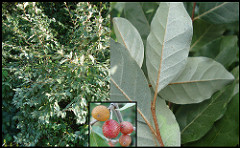 Autumn-olive (Elaeagnus umbellata) has silvery scales on leaf undersides, stems, and red fruit.
Photographer: Flickr user Ronald Kielb.The coarse, dry, sandy loam of the Chestnut Oak / Mountain Laurel Forest is not as hospitable to as many non-native invasive plants as some of the other natural communities in Rock Creek Park. Besides, dense colonies of native mountain laurel can make it difficult for all but the most hardy weeds to compete for root space and sunlight here. (* indicates non-native)
- autumn-olive* (shrub)
- linden arrow-wood* (shrub)
- winter creeper* (vine)
However, where trails cut through this community, or where it borders residential neighborhoods, extra sunlight and rogue seeds can make their way into this community, giving other plant species a foothold. This is part of what is called edge effect.
Stewardship
Here are a few ways Park staff are managing some of the ecological threats to the Chestnut Oak / Mountain Laurel Forest:
- Excessive deer browse: deer management plan in place since 2012 using lethal and non-lethal means1
- Gypsy moth: bacterial and viral insecticides, naturalized fungus, release of parasitic wasps
- Potential arrival of diseases and invasive insects: Vigilance of Park staff and visitors
Ecobit: An Extra Set of Eyes