

Natural Processes & the Broader Landscape: Oak - Beech / Heath Forest in Rock Creek Park
Natural Processes
What is responsible for forming and maintaining the “patterns” that we recognize as this natural community? What shapes the land, forms the soil and topsoil, influences the water supply and all the other things that bring and keep this suite of plants together? Natural processes. (Ecobit: Natural Processes)
A unique set of natural processes operates here. In the past, the physical setting of the Oak – Beech / Heath Forest at Rock Creek Park was shaped by
- geologic fault motion Ecobit: For Fault-Finders in Washington
- water cutting deeply through breaks or weaknesses in the bedrock (creating steep stream valley walls)
Important natural processes in the Oak – Beech / Heath Forest today include
- steep-slope processes (erosion, creep) leading to dry, erosion-prone shallow soils
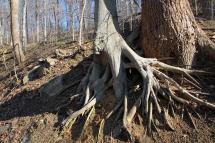
- bedrock near the surface, leading to shallow rooting, which leads to wind-thrown trees
- canopy gap regeneration
- cooler, shadier microclimate in summer compared to Rock Creek Park’s hilltop natural communities
Large-scale Natural Processes and Ecological Systems
Some natural processes act on large scales and affect more than one natural community at a time. An ecological system is a group of several natural communities that occur in the same region and share many of the same natural processes and aspects of physical setting. By extension, they may also share many of the same plant and animal species.
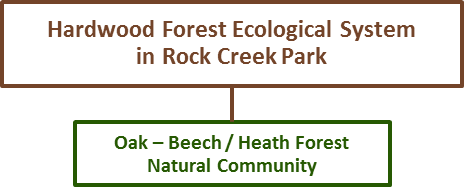
The Oak – Beech / Heath Forest is the only natural community in Rock Creek Park that is part of Rock Creek Park's Hardwood Forest Ecological System. (Beyond Rock Creek Park, this ecological system picks up more natural communities that do not occur at Rock Creek Park.)
Explore This Ecological System
Click the chart below to learn about this ecological system and its natural processes.