


At Home in Different Habitats
Learn More
Other Websites
Different plants are suited to different habitats. Just as you wouldn’t expect to find a deer living in a tree, you wouldn’t expect to find skunk-cabbage growing at the top of a dry ridge. Knowing more about the habitat needs of different plants can help you know where to find them in Rock Creek Park.
Explore this page:
- Why Don't All Plants Grow Everywhere?
- Predicting Location
- Putting It All Together: Natural Communities
Why Don’t All Plants Grow Everywhere in the Park?
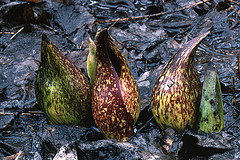 Skunk-cabbage (Symplocarpus foetidus) is found in areas where groundwater saturates the soil all or part of the year.
Photographer: Alfred SchotzJust because a certain plant lives in Rock Creek Park doesn’t mean you can find it anywhere you look. Every plant species requires or tolerates specific environmental conditions, and all have a limited range of environments in which they thrive.
Some plants do best in shade, others in sun. Some need fertile soil, others make do with infertile soil. Some can withstand floods, some can withstand droughts. Some can survive wildfires, some can’t, and some actually depend on fires. For more information on how different plants thrive in different conditions, see The Secret Lives of Plants in Ecology Basics.
In Rock Creek Park, skunk-cabbage may be the pickiest plant. It’s a specialist, meaning it requires a very specific set of conditions.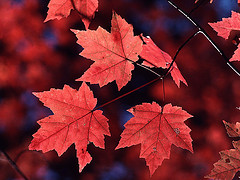 Red maple (Acer rubrum) is a "generalist"—able to grow in many environments.
Photographer: Gary Fleming Ecobit: Skunk-Cabbage and Groundwater
Red maple is probably the park’s least picky plant—you can find it in any of the park’s natural communities. It’s a generalist, meaning it can grow in diverse habitats.
The habitat where a generalist is often found is not necessarily the habitat where it would grow best. American hornbeam, for instance, tolerates occasional flooding, and is frequently found on floodplains. But it actually grows better on low slopes with moist but well-drained, rich soils.1
Predicting Location
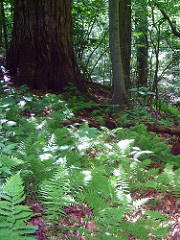 New York fern (Thelypteris noveboracensis) thrives in the muted light below sun-loving trees.
Photographer: Ery Largay, courtesy of NatureServeKnowing what conditions a plant can and cannot tolerate helps you predict where you will find it in nature.
Plants that require or tolerate similar conditions often grow together. For example, on the hilltops in Rock Creek Park, you will find plants that can tolerate dry, nutrient-poor, or acidic soils, with occasional fires. These plants might include dry-site oaks such as chestnut oak or scarlet oak, along with mountain laurel, hillside blueberry, or other members of the heath family. Ecobit: Heaths
On the other hand, plants that require complementary conditions grow together as well. For example, sun-loving trees that grow in the forest canopy create ideal conditions for shade-loving plants in the understory.
Look at the lists of habitat preferences below and think about which species might grow well together.
As you walk in Rock Creek Park, take note of some of the conditions that may be influencing the combinations of plants you see in different places. (See Physical Setting of Rock Creek Park to learn what sorts of conditions exist where.)
Putting It All Together: Natural Communities
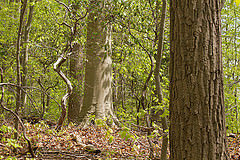 American beech, chestnut oak, and mountain laurel grow together on steep hillsides in the Oak - Beech / Heath Forest. Can you figure out why?
Photographer: Sam Sheline, courtesy of NatureServeAfter learning about habitat preferences of some of the plants (below), explore the Plants and Animals pages of Rock Creek Park's natural communities to see examples of natural groupings of plants.
Can you see why they're a natural fit?
Habitat Preferences for Some Plants at Rock Creek Park
Note: Habitat preferences for non-native plants common at Rock Creek Park are discussed in Non-Native Invasive Plants.
Shade tolerant or semi-tolerant:
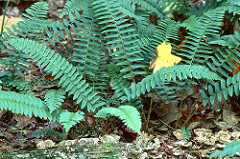 Christmas fern grows on shady forest floors.
Photographer: Gary FlemingAmerican basswood, American beech, American holly, American hornbeam, American witch-hazel, black huckleberry, Christmas fern, common serviceberry, ferns, flowering dogwood, hillside blueberry, mountain laurel, northern spicebush, oak seedlings (Ecobit: Oaks: Shade Tolerant?), partridgeberry, pawpaw, pink azalea, red maple, wild hydrangea, sugar maple (may or may not be native to D.C. Ecobit: Maple Tree Mystery at Rock Creek Park)
Requires more direct sunlight during part or all of its lifecycle:
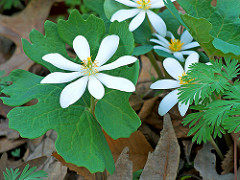 Spring ephemerals like bloodroot and Dutchman's breeches need early spring sunlight, before trees leaf out.
Photographer: Gary Flemingoaks (Ecobit: Oaks: Shade Tolerant?), most pines (for seedling establishment), sassafras, tuliptree (for seedling establishment), spring ephemerals (Ecobit: Spring Ephemerals) such as bloodroot, cutleaf toothwort, Dutchman’s breeches, mayapple, smooth Solomon's seal, Virginia springbeauty, Virginia bluebells, yellow trout-lily, (and many other spring ephemerals), and essentially all meadow species
Tolerates either shade or full sunlight:
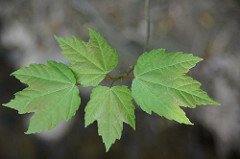 Fresh new spring leaves of red maple grow in the understory.
Photographer: Matt Jonesred maple
Fire-adapted (can survive or leave surviving offspring after some degree of fire):
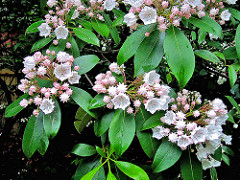 Mountain laurel resprouts from underground rhizomes after fire.
Photographer: Gary Flemingblack huckleberry, blackgum, chestnut oak, hillside blueberry, mountain laurel, pink azalea, pitch pine, Table Mountain pine, and many meadow species (See also Ecobit: Fire-Tolerant or Fire-Dependent?)
Fire-intolerant:
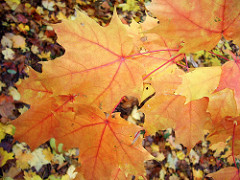 Sugar maple doesn't survive fire.
Photographer: Ery Largay, courtesy of NatureServeAmerican beech, American holly, red maple, sugar maple (may or may not be native to D.C. Ecobit: Maple Tree Mystery at Rock Creek Park), and most other species in the park
Germinates quickly on disturbed land sites:
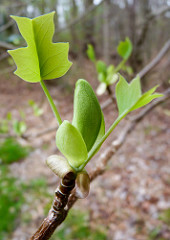 Tuliptree grows well on cleared land.
Photographer: Matt Jonesblack locust, pines, red maple, sassafras, tuliptree
Tolerates nutrient-poor, acidic soil:
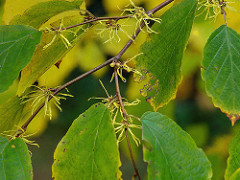 Witch hazel can be found on steep slopes.
Photographer: Gary FlemingAmerican beech, American witch-hazel, black huckleberry, chestnut oak, hillside blueberry, mountain laurel, pink azalea
Prefers nutrient-rich soil:
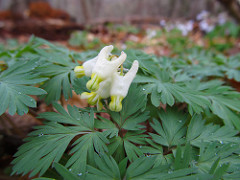 Dutchman's breeches grow best in nutrient-rich soil.
Photographer: James AndersonAmerican basswood, American bladdernut, American hornbeam, bloodroot, Canada wood-nettle, Dutchman’s breeches, mayapple, northern spicebush, pawpaw, sugar maple (may or may not be native to D.C. Ecobit: Maple Tree Mystery at Rock Creek Park), Virginia bluebells, white ash
Flood-tolerant (can survive or leave surviving offspring after some degree of flooding):
Spicebush is at home on floodplains.
Photographer: Gary Fleming
American bladdernut, American elm, American hornbeam (semi-tolerant), box-elder, Canada wood-nettle, cinnamon fern, green ash, mayapple, northern spicebush, red maple, river birch, skunk-cabbage, swamp azalea, American sycamore
Drought-tolerant:
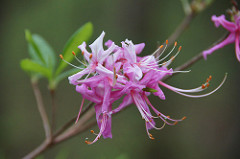 Pink azalea can grow well in droughty soil.
Photographer: Matt Joneschestnut oak, black huckleberry, hillside blueberry, mountain laurel, pink azalea, scarlet oak